Three Pubs, One Appetite: How to Build an Afternoon That Peaks at the Right Table

Most pub crawls fall apart for the same reason. Nobody planned the food. The route gets all the attention, the timings get argued over on the group chat, and then everyone arrives at stop three at half four, half-starved, and orders the biggest thing on the board because it's there. That's not a crawl. That's an unplanned dinner with two drinking detours bolted on the front.
A food-first crawl runs the other way around. You pick the plate that matters, then build the afternoon backwards from it. The pubs become supporting acts. The walk between them becomes the thing that makes room for the next course, rather than the thing you resent.
Decide which pub carries the meal before you leave the house
One stop should own the sit-down. One. Not two, and certainly not three, unless you've got a Sunday roast ahead of you and a very forgiving Monday.
Pick the pub with the menu you actually want to eat, not the one with the most convenient postcode. That means checking the boards online the night before, or ringing the week before if it's a small kitchen that changes with the season. A pub doing one hot dish well on a winter afternoon is worth more than a laminated menu offering forty things badly.
Once that main meal is placed, the rest of the afternoon has a spine. Everything else is trimming.
Stop one is a snack stop. Treat it that way.
The first pub of the afternoon is where excited people accidentally eat a full meal at 12:30 and then spend the next five hours wishing they hadn't.
Order at the bar, not the table, and keep it to one round of small things: a scotch egg cut in four, a pork pie, a bag of proper crisps and a pot of something pickled. Six or seven quid a head is about right. Enough to blunt the first pint without touching your appetite for later.
This is also the stop where you learn something about the pub's kitchen. If the scotch egg turns up fridge-cold with a grey ring around the yolk, you've got useful information. Not every stop needs to be a gem, but the first one shouldn't be a landmine.
The ninety-second test: does this pub get a second pint?
Halfway through stop one, ask the question. If the answer is no, you've got a one-pint stop on your hands, and that's fine. Good crawls are built out of one-pint stops.
Signs a pub is a one-pint stop:
- The bar staff are already stacking chairs at half two
- Every table is sticky in a way that suggests nobody's wiped it since Sunday
- The menu is photocopied and the prices are oddly high for what's on it
- The only seat is next to a fruit machine that plays a tune every forty seconds
Signs a pub deserves the full sit-down:
- Someone's carrying a plate of chips past you and you involuntarily turn your head
- There's a handwritten specials board with a date on it
- The roast is carved to order, or the pie has a suet crust and not a puff lid
- You can see into the kitchen, and it looks like a kitchen and not a cupboard
You don't need to be scientific. You need to be honest at the ninety-second mark rather than an hour and three pints deep, when every pub looks like a good idea.
The walking is the point, so give it a job
A crawls works when the walks are long enough to be useful and short enough to be pleasant. Somewhere between fifteen and twenty-five minutes suits most people. Any less and you're just moving the same crowd to a different set of optics. Any more and boots, weather and bladder maths start to dominate the day.
Think of each walk as a palate reset. Fresh air, a bit of pavement, a look at a church or a river or a row of terraces that someone in the group will insist on calling 'proper' housing. By the time you reach the next door, you've earned the next order.
It also burns off the pint, or at least gives you the comforting illusion that it does.
Stop two is where good crawls quietly die
This is the danger pub. It's the one in the nice spot with the big beer garden, and everyone wants to settle in. That's fine, unless stop two is also where you eat, and then also where you have a third pint, and then also where you decide the third pub is probably too far.
Hold the line. At stop two, order either a drink and nothing else, or one shared plate between four people, maximum. A bowl of chips is a public service. A plate of nachos is a meal pretending to be a snack, and it will silence the table for forty minutes.
Save your appetite. The main meal is still coming.
The main event wants a proper table and a proper hour
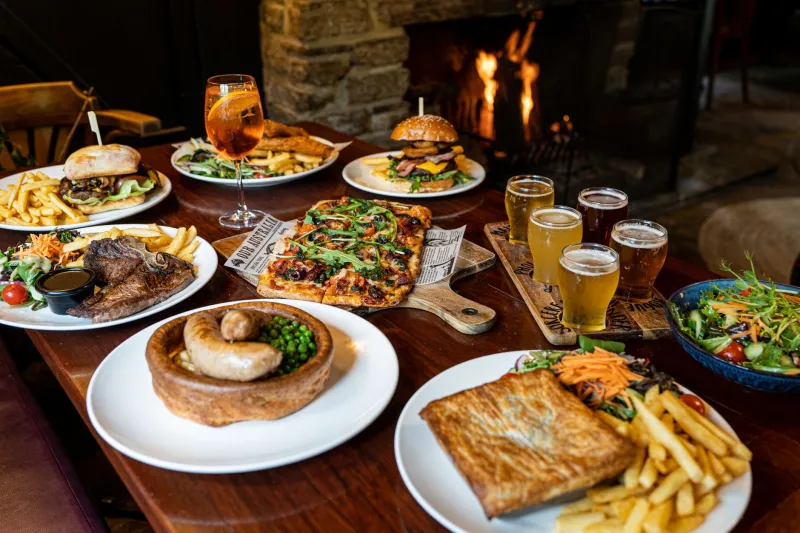
By stop three you should be hungry, mildly windblown, and absolutely certain about what everyone's ordering. Sit down properly. No leaning on the bar. Take a table, read the whole menu, ask what's good, and give the kitchen an hour of your afternoon.
Order one main each. Resist the urge to add three sides and a starter 'for the table' unless there are six of you. Pub portions in this country are generous to the point of aggression, and the chip mountain is not a challenge, it's a warning.
If you want a pudding, share one between two. Nobody has ever regretted half a sticky toffee pudding. Many have regretted the whole one on top of a pie.
And then the dinner question
Plan for a last-pint stop rather than a fourth meal. Somewhere with a fire, low ceilings, and no food menu beyond a packet of pork scratchings. That's how the afternoon lands nicely, and it leaves a bit of room for whatever the evening decides to become.
If dinner isn't happening, that's fine too. Just don't build a crawl that assumes you'll want a full meal at six and then discover at five that nobody can face it. Better to end hungry for the next time than stuffed and swearing off pubs until February.
The short version, pinned to the fridge
One meal, one pub. Snacks at the first, restraint at the second, sitting down at the third. Drink slower than you walk. Order less than you think you need. Leave the fourth stop to chance.
Do that and the crawl stops being a endurance event with pints on the side. It becomes what it should have been all along: an afternoon of decent food, taken at walking pace.