Early Carving or Late Gravy: Booking the Sunday Roast You Actually Want
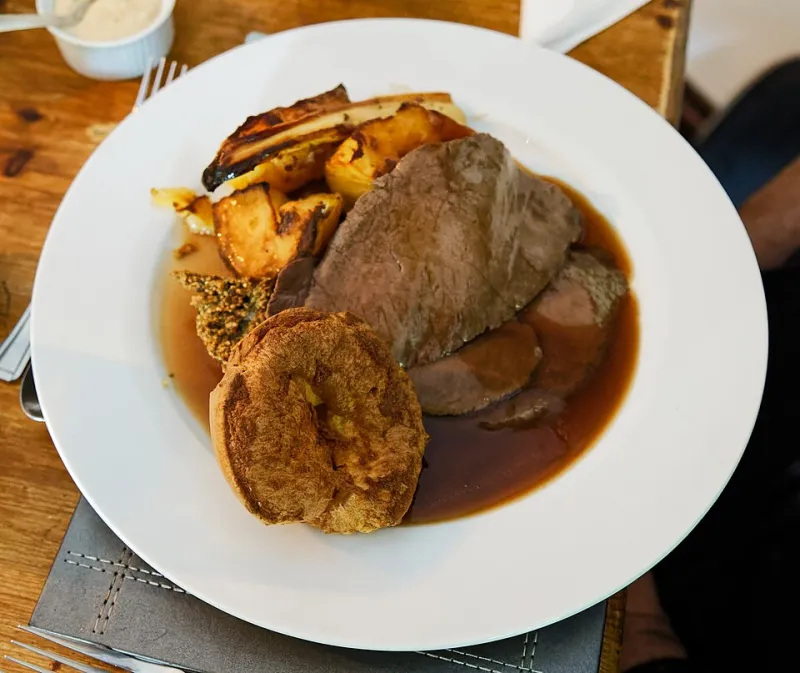
Photo: Acabashi, CC BY-SA 4.0, via Wikimedia Commons
There is no such thing as “a Sunday roast” in the singular. There is the noon roast, all elbows and anticipation; the two o’clock roast, settled and generous; and the four o’clock roast, which is a different creature altogether. Same pub, same menu, often the same joint — but the plate in front of you depends on when you sit down. If you are booking a table this weekend, it is worth thinking about the hour as part of the meal, not just a slot in the diary.
The early sitting: choice, carve, crisp
The first sitting of the day tends to be the most alert. Joints have been rested, Yorkshires are still tall, and the roast potatoes have that glassy edge that only exists before the steam trays have been opened and closed a few dozen times. If you want first pick of the beef, the lamb, the pork with crackling, or the vegetarian option that isn’t an afterthought, book early. You are paying for range as much as for lunch.
This is also the sitting where the kitchen is still working at full concentration. Carving is neat, gravy is being poured to order rather than ladled from a deep, dark urn, and the vegetables have not yet begun to surrender their texture. The downside is atmosphere: the pub can feel half-asleep at 12:15, and you may be eating while the staff are still setting out the condiments. If you want a quiet table and the best chance of the full menu, that is not a problem. If you want a bit of bustle, it is.
Signs you are in the early window: every meat is still listed on the board, the server does not have to check whether the cauliflower cheese is available, and the Yorkshires are arriving at tables in matching sets rather than as survivors.
The middle stretch: rhythm, gravy, company
A 2pm booking is often the sweet spot between choice and atmosphere. The pub has filled up, the kitchen has found its pace, and the roast potatoes have had just enough time in the tray to pick up a little more flavour without turning to mash. The gravy may be a touch darker and thicker than it was at noon — not a flaw, just a stage of the day. It clings to the meat rather than running off it, which some of us prefer.
The middle sitting is also the most social. Families are in, the bar is doing a steady trade, and there is a pleasant hum that makes a second pint feel inevitable. The risk is that you are eating at the busiest point. If the pub runs a carvery, the queue can snake past the fruit machine; if it plates from the kitchen, the pass can get stacked. Ask how the service works before you book, especially if you have small children or a train to catch.
Signs you are in the middle stretch: plates are leaving the kitchen in a steady stream, the carvery has a queue but it is moving, and staff can tell you exactly which joint is running low without leaving the floor.
The late plate: generosity, compromise, calm
By 4pm, the roast has usually relaxed into something else. The Yorkshires may be smaller or fewer, the crackling may have lost its snap, and the beef is more likely to be carved from the end of the joint. But the late roast has its own virtues: the pub is quieter, the kitchen is not rushing, and the gravy has had hours to become properly savoury. It can feel less like a service and more like a long, slow afternoon.
This is the sitting to choose if you care more about conversation than choice. It is not the one to choose if you have your heart set on a particular cut or a towering Yorkshire. The late roast is not a lesser roast; it is a roast with the edges knocked off. Sometimes that is exactly what you want. Other times it is a disappointment you could have avoided with a phone call.
Signs you are in the late window: items are being crossed off the menu board, the carvery trays are being scraped rather than replenished, and the staff are starting to talk about the evening menu. None of that is a red flag on its own — but it does tell you what kind of meal you are getting.
What to ask when you book
A good pub will not mind a few practical questions. Ask which joints are still available at your chosen time, whether the carvery is served right through the afternoon, and whether Yorkshires are made in batches or all at once. If you are booking the last sitting, ask what tends to run out and whether the kitchen keeps anything back. If you want the full choice, say so — most places will happily steer you towards an earlier table.
It is also worth asking how the roast is served. A plated roast and a carvery are different experiences, and the timing affects them differently. A carvery at 4pm can still be generous if the trays are topped up; a plated roast at 4pm depends more on whether the kitchen is still cooking to order. Ask, too, whether there is a gap between sittings. That half-hour reset can be the difference between a relaxed late lunch and a table that feels like it has been handed over in a hurry.
A simple rule of thumb
Book early for choice and crisp edges. Book the middle for atmosphere and a proper gravy-soaked plate. Book late for calm, conversation and a more forgiving pace — but ring ahead if you have a particular cut in mind. The roast does not stay still just because the menu does. Pick the hour that matches the meal you want, and Sunday lunch becomes a lot less of a lottery.